Chamber of Architecture and Spatial Planning of Slovenia (ZAPS)
Standards that speak everyone's language
A communication strategy and editorial plan that bring the standards of the Chamber of Architecture and Spatial Planning of Slovenia closer to architects, clients, the media and decision-makers.
- Client
- Chamber of Architecture and Spatial Planning of Slovenia (ZAPS)
- Year
- 2024–2025
The Chamber of Architecture and Spatial Planning of Slovenia has created a collection of six ST ZAPS standards. They describe in detail the services of architects and landscape architects, how those services are valued, and what plans must contain and how they are drawn.
The standards benefit everyone involved in building, from the architect to the investor. But only if they know them.
01The challenge
The standards were created by the profession, but their benefits reach far beyond it. They help private clients understand what they get from an architect, public clients compare offers, and decision-makers draft regulations.
Yet many people do not know them or see no added value in them. Not even architects. A survey of 126 architects by the Chamber (2022/23) showed:
Starting point
- 45%
- never use the standard on design services (ST ZAPS 01)
- 42%
- never use the standard on valuing services (ST ZAPS 02)
- 47%
- fall short of the recommended minimum value of a standard office hour
- They don't know them well enough.
- They see no added value.
- They think they already know everything.
- Clients only see the price, not the scope and quality of the service.
- A precisely defined price for services.
- Less risk of mistakes.
- Comparable offers for clients.
- A common language for every profession involved in building.
02The solution: one standard, eight audiences
Together with the Chamber, we completed the communication strategy and prepared the editorial plan for 2024/2025. The starting point was a simple question: what problem do the standards solve for each target group?
Communicating architecture moves between two extremes. On one side is hermetic, professional communication among architects, full of technical terms. On the other is heretic, popular communication for clients, the media and the general public. We placed eight target groups between the two and found the right language for each.
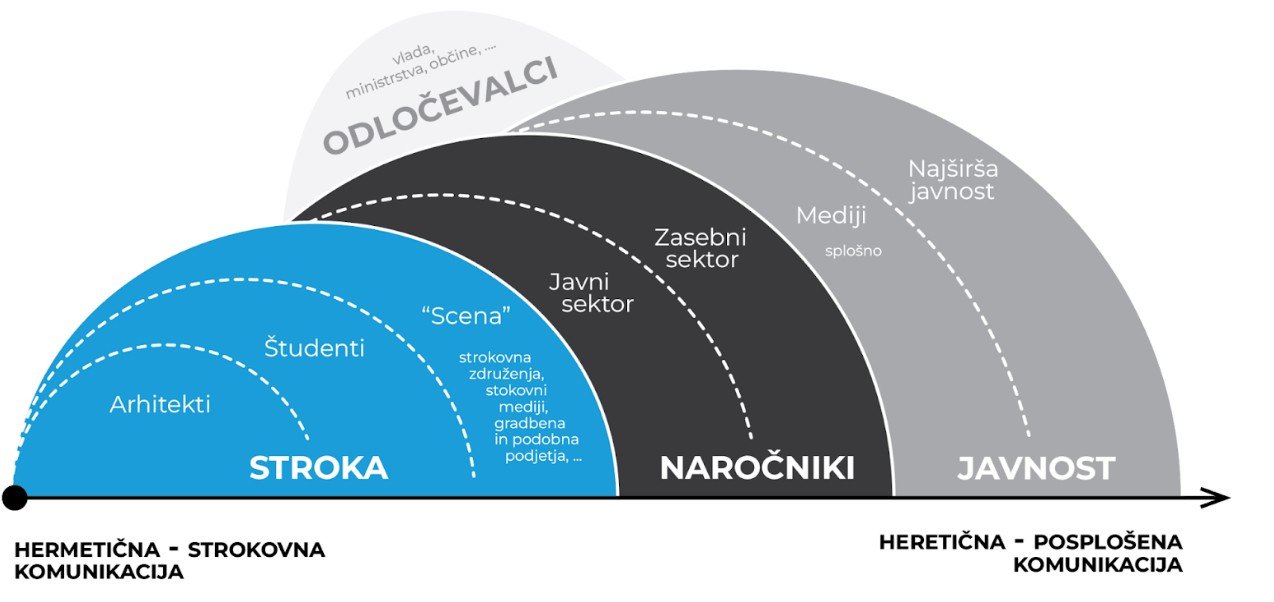
What the standards give to whom
“The standards give me information that helps me optimise my work and charge for my services more easily.”
Why they need them: they give a sense of security that offers, contracts and deliverables are done right, they make it possible to charge for all services provided, and they protect architects in their relationship with clients.
Why they don't use them yet: they don't know them well enough, see no added value or think they already know everything.
“The standards give me knowledge that prepares me for my career.”
Why they need them: volumes 3 and 4 are a real textbook on drawing architectural plans, while volumes 1 and 2 help once they start working in a studio or on their mandatory internship.
Why they don't use them yet: they don't learn enough about them at university.
“The standards bring a shared knowledge base and better communication between professions.”
Who they are: associations, professional media, construction and related companies.
Why they need them: associations know where to look for solutions, builders read uniformly drawn plans more easily, and all professions speak the same language.
Why they don't use them yet: they don't know them and don't see their practical value.
“The standards bring more transparent and better public procurement.”
Why they need them: they get comparable offers more easily, follow public projects more easily and keep better control of public money.
Why they don't use them yet: they often don't know they exist. Municipalities usually lack the know-how to manage investments.
“The standards give me better control, easier execution and a better project.”
Why they need them: they protect clients in their relationship with the architect, make offers comparable, make it easier to follow construction phases and help avoid problems during building.
Why they don't use them yet: they don't know what they get from an architect, so they compare offers on price alone.
“The standards bring more credibility and make it easier to write about building.”
Why they need them: a better understanding of architectural processes means more accurate and credible reporting. Construction and architecture are important industries and news topics.
Why they don't use them yet: they don't know the standards exist.
“I understand that architecture is a professional discipline.”
Why they need them: knowing that standards exist helps avoid many problems when building.
Why they don't use them yet: the topic doesn't interest them, and they don't know enough about the architect's role.
“The standards bring better policies and regulations.”
Who they are: ministries and municipalities.
Why they need them: they simplify bureaucratic procedures, since regulations can refer to parts of the standard instead of listing details.
Why they don't use them yet: some don't know they exist or don't see how they make drafting regulations easier.
03Three levels of content
Following Google's three-level model, we sorted the content by importance and frequency of publication. Every path leads to the same touchpoint: the Chamber's website, which is both a library of standards and an archive of content.
-
01
Basic content
Evergreen content: an infographic overview of the standards, frequently asked questions on the Chamber's website and copies of the standards in libraries.
-
02
Regular posts
Monthly infographic stories, short explainer videos, webinars, the Construction Project Phases leaflet, expert articles and presentations at universities.
-
03
Highlights of the year
An appearance at the Ambient fair, an interactive quiz on the standards, training for public clients at the Administrative Academy and events for the profession.
04Infographics: the standards at a glance
For a first encounter with the standards, we prepared a series of infographics. They show what the standards give architects, investors and builders, how they relate to legislation and professional rules, how they follow the life cycle of a building and what affects the price of architectural services.
05Events: the standards live
For face-to-face contact, we designed formats tailored to each audience: for the profession at Architects' Day and for potential clients at the Ambient fair.
-
01
“Do you speak architecture?”
A round table at Architects' Day on a common language between professions. The standards are one of the steps that help us all speak the same language.
-
02
“Don't let your dream house turn into a nightmare!”
A talk for visitors to the Ambient fair: examples of good and bad practice show how the standards make building and renovating less stressful.
-
03
“A good house needs good communication, not just bricks and mortar.”
A conversation between an architect and a builder about the most common misunderstandings in construction and how to avoid them by speaking the same language.
06A year of communication on one timeline
We placed all activities on a timeline from August 2024 to August 2025. The editorial plan gives the Chamber an overview of its communication with every audience and helps align the strategy with day-to-day posts.
Channels: website, newsletter, LinkedIn, Facebook and Instagram, general and professional media, libraries, leaflets, universities and related organisations and associations.
The editorial plan in numbers
- 8
- target groups, each with its own message
- 3
- levels of content: basic, regular and highlights
- 15
- content formats, from infographics to a quiz
- 13
- months on the timeline
07Conclusion
The Chamber now has a strategy it can carry out step by step: each target group has its own message, its own channels and its own place on the timeline. The standards are no longer just a set of rules for architects, but a common language for everyone involved in building.
08Where this project sits in our matrix
We work across all of these layers, and any combination is possible.
- Who we work for
- Executive leadershipCorporate communicationsHRMarketingPublic sector
- Project scope
- Small brand story (e.g. a single video)Always-on communicationBig brand story (a full campaign)Leadership transformation
- Levels of work
- Strategy and creative developmentImplementationProduction
- What we improve
- ProcessesRelationshipsContent
- Approach
- StrategicDigital and AI-poweredCreativeAdvisory
- Duration
- Short-term (up to 3 months)Mid-term (3–12 months)Long-term (a year or more)
- What we create
- DocumentsPresentationsVisual identitiesDesignWebsitesSocial mediaCopywritingPhotographyVideo storiesAnimationsPodcastsEventsWorkshops